Monday, October 13, 2008

Table Mountain


Table Mountain is the backdrop to Cape Town, and forms a long, almost flat-topped ridge flanked by several peaks on either side; the silhouette of these symbolizes Cape Town throughout South Africa. The seventeen to the west are called the Twelve Apostles.

The cable-car to the top is the first I’ve ever been in where the floor rotates!

The view from the top is amazing. We couldn’t see to the Cape of Good Hope becaue of the low clouds, which were actually below where we were.

A mist comes in from the Indian Ocean and moves across the plateau of the mountains. As it descends on the Atlantic side it forms a cloud that rolls over the edge and down the face a short distance before evaporating; a phenomenon called ‘the tablecloth.’

First real day of Tourism in Cape Town


Today, Sunday, was the first real day of visiting Cape Town like a tourist. Rebekah, my colleague from work who was also attending Congress, and I have planned three days of exploring Cape Town and this part of South Africa.

We got tickets for the Hop-on-Hop-off bus tour that goes throughout the town, and first visited Kirstenbosch Botanical Gardens. Wonderful collection of flowers, trees, and cycads.

The gardens were donated by Rhodes, of scholarship, De Beers Diamonds, and Rhodesia fame. When he died a "confirmed bachelor" (and we know what that meant in the old days), he was one of the richest men in the world, and left the bulk of his estate to the state. Spending the morning in the warm sunshine and amongst the beautiful gardens was a real tonic after several days of meetings.

A few pics of Cape Town.


Here are a few more pics of Cape Town, taken from a walk up Lion's Head. The clouds billowing over the '12 Apostles' is further up the shore from Sea Point. Table Mountain overlooks the city, and on the very peak of it, you can see the top station of the cable car.

Friday, October 10, 2008

Cape Town


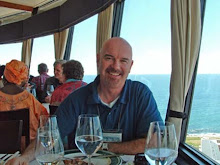
Here are a few pictures from around Cape Town. Me at the revolving restaurant at the "Top of the Ritz," aka the vertical hav-a-nap. A nice old dutch-style house in Cape Town, with the S.A. flags flying in a stiff breeze. Downtown Cape Town and the Old Slave Church; built in 1803 it was a mission for education and emancipation of slaves. The two other pictures are the music-and-dance troupe that kicked off the final day of Congress with about an hour of African music. I don't have the name of the group in the original language, but it translated as 'Rainbow,' as the members and the music are from throughout Africa. In one picture they are playing horns made from the horn of the Antelope. At one point they invited audience members to come up and join them. Of course, i went, and was given one of these horns. The woman int he middle coached me, and I managed to get some squaks out of it, but not exactly melodious. Take a lot of wind (no comments, please!). Some friends have pictures of me on stage, so I'll add those when they get sent to me.

Thursday, October 9, 2008

Robben Island, Cape Town


Wednesday afternoon was spent at Robben Island, the prison island just off Cape Town. Originally built as a leper colony and later used as a military station, it became a prison in the Apartheid era specifically for ‘Coloureds and Blacks.’ The ‘Whites’ were in another prison on the mainland. The racial divides were maintained here in the strangest ways: Coloureds got a better ration of food, as well as winter clothes; the Blacks got a simpler diet (and less of it), as well as only short pants and short-sleeve shirts (even for winter). Apparently long pants were handed out in the event of Red Cross visits. Men slept 80 to a dorm, with no mattresses or beds: only two quilted blankets each, one serving as a mat and the other as the blanket.

The quarry is where all prisoners worked five days a week. Most got lung and eye disease from the limestone dust and glare off the white rock. The prisoners worked out a system for talking here, since this was the only place in which they were watched from some distance: they would work in groups of five to eight and while the two end men actually worked the rock face, the others in between would fake their work. The noise would from the two workers would cover the conversation of the others.

One building was purpose-built for a single prisoner: Robert Sobukwe, the initiator of one of the first uprisings in the 1960’s, the burning of identity cards required only by ‘Coloureds and Blacks.’ This non-violent protest eventually sparked major clashes between protesters and police, and Sobukwe was imprisoned. The sentence was life solitary confinement, and he was refused any social interaction. Not even his guards were allowed to speak with him.

The main prison block is where Nelson Mandela was kept. This part of the tour was actually guided by former prisoners of Robben island. They, in fact, were major forcesin having the island declared a heritage site. Our guide was Mr. Sparks, who was arrested and imprisoned for inciting resistance to Apartheid, and was there for some eight years. He took us into his own dorm. Adjoining the dorm were the washroom facilities: two toilets, urinal trough, three showers, and five sinks for eighty men. Only cold water, even in winter.

Nelson Mandela had a solitary cell, about ten foot square. Only two mats, bucket for a toilet, and a table and chair. No heat. Our capacity for cruelty, domination, and humiliation seems to be boundless.

The catamaran ferry that takes you to Robben Island is called ‘Sikhululekile,’ which means “We are free now.”

Gugulethu Township


The mid-point of the conference was a break-away from the sessions and learning groups. The first half of the day was a visit to Gugulethu Township. When Apartheid was enacted, Blacks and Coloureds (the official S.A. term for anyone of Asian or ‘mixed’ racial background) were forcibly removed to settlements isolated from the Whites. Gugulethu is about half-an-hour from Cape Town, and is a dense neighbourhood of houses, shops, churches, businesses, etc. In contrast to the so-called ‘informal settlement’s which are the corrugated metal shanty-towns, Gugulethu seems almost middle-class, but it is certainly not wealthy or even comfortable.

We were hosted by the Gugulethu Presbyterian Church. Note in the picture that all the windows are barred, and the church is surrounded by a high metal fence with razor wire on top. This is typical of most houses and buildings in many parts of Cape Town. Even low walls that can be easily climbed over will have strips of sharp metal spikes protruding from the top to discourage people from hopping over, or even sitting on the wall. It’s really unclear whether there is a serious safety threat this is meant to address, or is more symbolic of security and a siege mentality. I’ve wandered around a bit in our neighbourhood, and not felt at risk at all, but all the nearby houses are protected like this.

Pastor Mzukisi at the church in Gugulethu did speak of the social conditions, noting that the poverty is now wreaking more damage on the social fabric than the remnants of Apartheid. Adding to the problem is the HIV AIDS pandemic, in which one in four deaths in Africa is now attributable to AIDS. With so few resources, medication and medical care are beyond reach when there isn’t enough money for basics such as food, shelter, and clothing. A member of the church spoke about her diagnosis with HIV, her struggles with the stigma, and trying to get the money for medication. We also heard from an older woman who grew up during the Apartheid era and was resettled numerous times, eventually settling in Guglethu.

The whole Apartheid ethic was based on eugenics, much like Grant and I saw on exhibit in Ottawa at the War Museum. Here they used a number of simple measurements to determine where a person fell in the race spectrum from white to black. It wasn’t about blood lines as much as about appearance. We heard of a story where two brothers, children of a mixed marriage (married before Apartheid outlawed such relationships), were determined to be of different races and segregated because one had characteristics of the white mother, and the other characteristics of the black father. The system ruled where you could live, work, and travel, your education and work, and relationships. And somehow it was rationalized to be, well, rational.

Like churches everywhere, Gugulethu Presbyterian runs on the sweat of the women. About the same time we arrived (about 300 of us) a dozen women also arrived bearing the makings of the meal. While we listened to the ministers and the to stories of Koleka and Nonkosi, the other women were cooking up a storm. We had a great meal of rice and bean, carrots and greens, and some kind of curry. The women sang African hymns and danced in a tight circle while we were eating. Everyone does seem very warm and friendly, interested in hearing about Canada and places far away, and despite the hardships seem to have a joy in life.

Tuesday Congress

Today started off much cooler and over-cast after last night’s spectacular sunset. Day two of the Congress was very full with a number of films and speakers. The first session was on gender justice with Joanne Sandler giving a great discussion on media and gender justice. Pretty hard for women to get a fair shake in the media, when over 80% of reporters and commentators are men. She had a whole series of clips from TV about Hilary Clinton, and how she was portrayed in the media. She also had a collage of print images of Hilary that made her look anything from stupid to viscous. I’m not a Hilary fan, but when a TV commentator says he automatically crosses his legs when he sees her on TV, (and that’s one of the milder segments) it’s a bit over the top. Thank you Fox.

The second session was a film and discussion, based on the film “Shock Waves.” It profiled the work of Radio Okapi in Democratic Republic of Congo that was challenging the actions of the government and uncontrolled militia that were barricading traffic on the Congo river and extorting money from the locals for traveling along the river. The use of advocacy journalism combined with broadcast media put pressure on the government and military, but also helped mobilize the people into effective resistance; at huge risks to radio-jouranlists. The film was really well done, won numerous awards and was produced with support from the CBC and TeleFilm Canada; something we Canadians can be proud of!

The other film was supposed to be followed by a discussion, but that didn’t really happen because the film literally left most of the audience speechless. “Sometimes in April” chronicled the Rwandan genocide through a fictional family, from the ethnic tension created when the Belgians colonists left, through the rising hatred and mistrust to the eventual massacre of close to 100,000 people. Many parts of the film were taken from authentic sources, but woven together into a narrative. Julienne M. who works at WACC and is from Rwanda, introduced the film and told a bit of her own story of escape and loss of many friends and members of her family.